UC
Use Case Lab
Back

Cities & Governance

Verifiable Cities

An open call for implementations examining where coordination and verifiability constraints are most acute in urban systems, and where public blockchains can meaningfully expand civic and state capacity.

Overview

Cities are increasingly expected to deliver public services with greater effectiveness and accountability. While many are beginning to adopt AI and data-driven systems, a shared digital foundation to support coordination and verifiability across organizations and domains remains largely absent. As a result, long-standing public-sector challenges—such as fragmented data sharing, citizen privacy concerns, slow financial flows, and high compliance and reporting costs—continue to divert institutional capacity away from improving services and outcomes. Instead, this capacity is often spent managing public trust through short-term political negotiation and manual administrative processes.

Rather than introduce new fully centralized or closed platforms, as previous and current government modernization efforts have done, recent advances in public blockchains make it possible to transparently embed verification, accountability, and coordination capabilities directly into how public rules and finances operate. These technologies offer a practical path to increasing state capacity without expanding state power and vendor control, or adding further administrative overhead. In doing so, they can enable the development of a shared digital "trust" layer across cities that extend accountability from administrative processes to transparent technical mechanisms.

Downloadable PDF:

Download the full Verifiable Cities Program Brief (PDF)

Why Cities
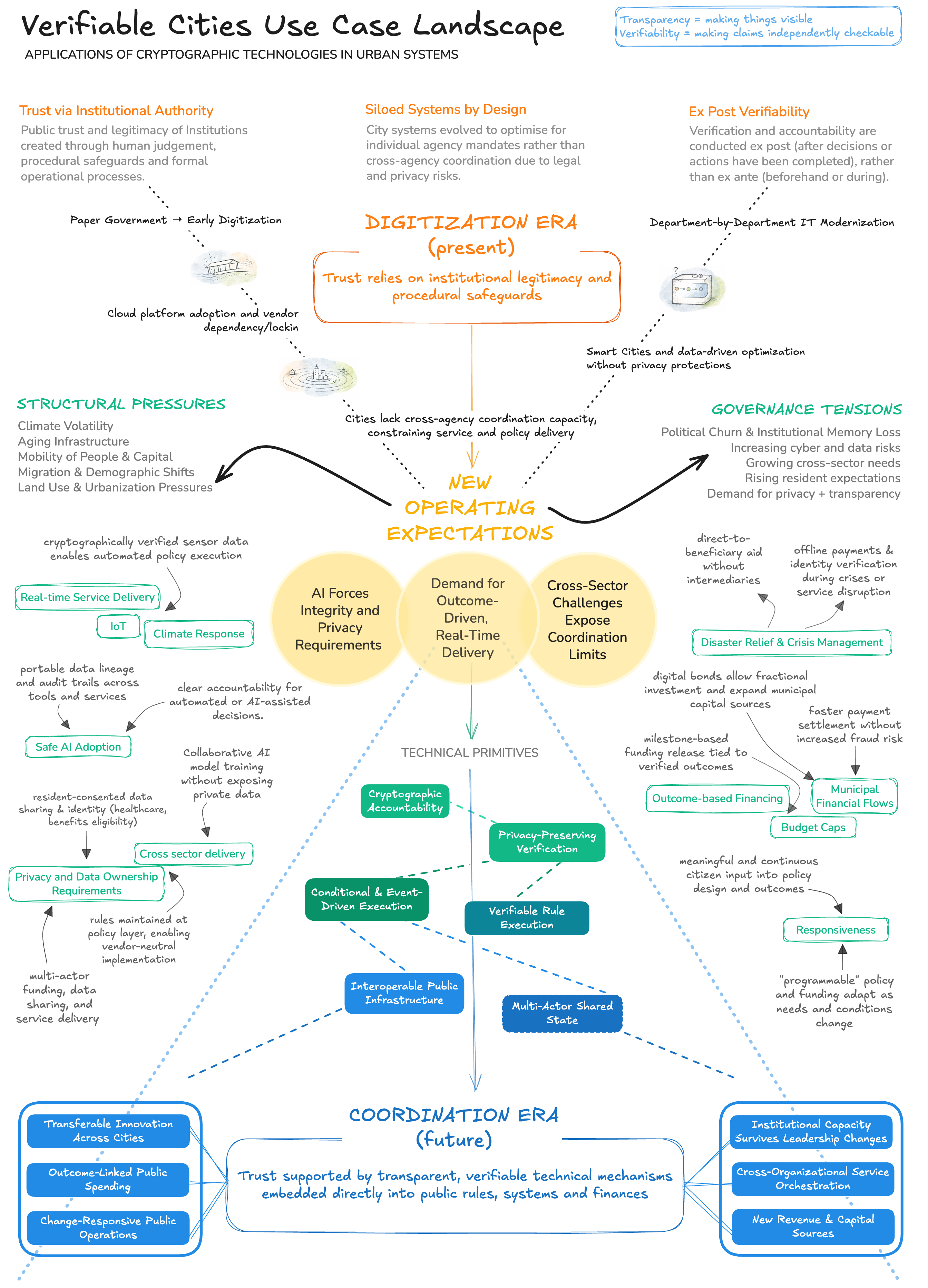
  • HYPOTHESIS #1: Cities are the primary institutional level where coordination and service delivery must happen in real time due to their proximity to operational pressure.
  • HYPOTHESIS #2: Cities face immediate service demands, operate across dense networks of public and private actors, and contend with real implications and constraints that require equally pragmatic solutions.
  • HYPOTHESIS #3: Despite wide variation in competitive pressures and context, thousands of municipal governments and service providers worldwide face common operational needs, creating clear but currently underleveraged opportunities for experimentation and knowledge transfer.
  • HYPOTHESIS #4: Together these conditions make cities powerful levers for public sector innovation, offering a scalable pathway for modernizing civic and state capacity.
  • Verifiable Cities Landscape

    Call for Implementations

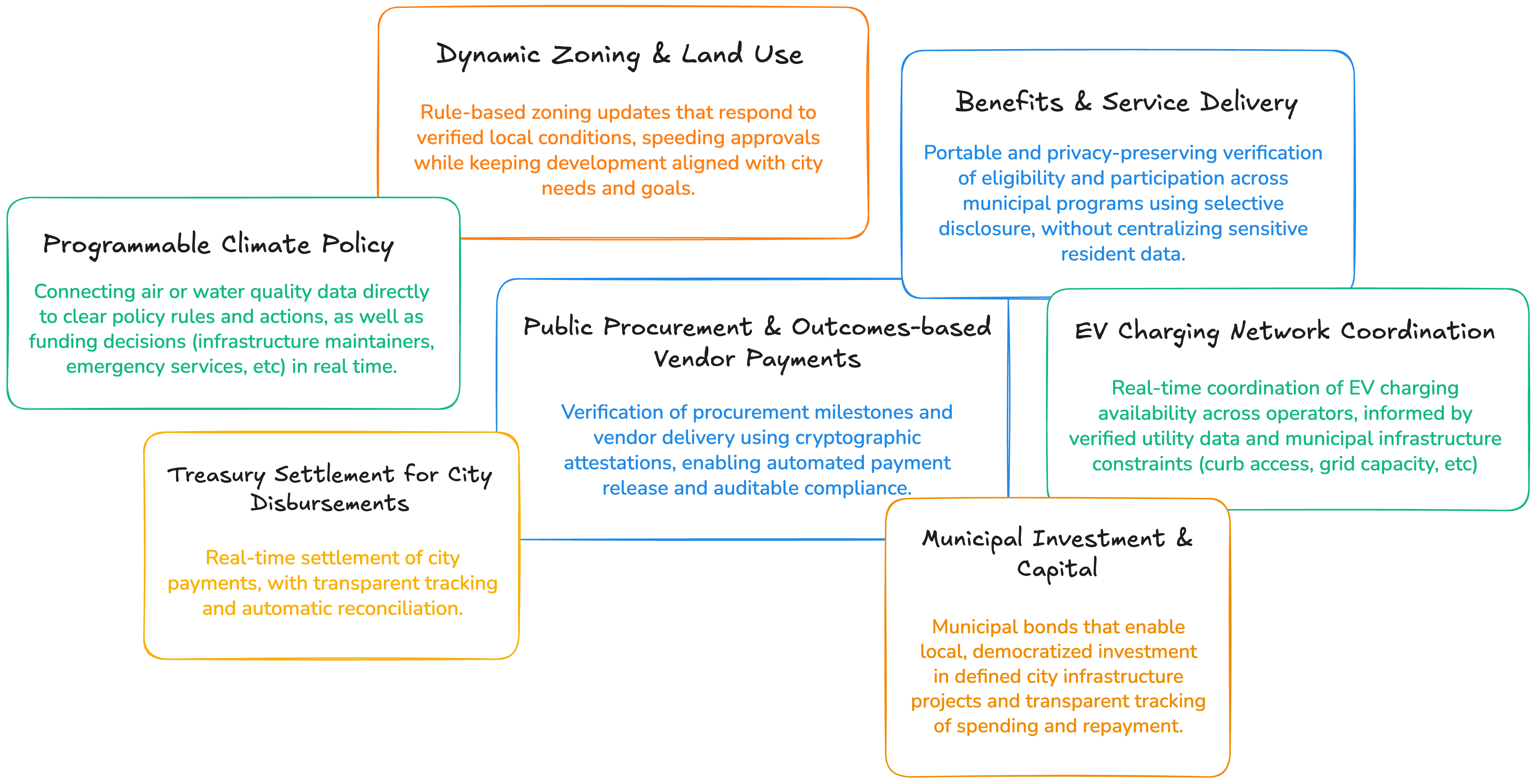
    The Verifiable Cities landscape is intended to frame early areas of inquiry and surface concrete use cases with the potential to meaningfully improve city operations and outcomes.

    As part of this work, the Ethereum Foundation Use Case Lab is issuing an open call for implementations. The work is oriented toward collaboration with city and regional governments, as well as other funders and organizations engaged in municipal innovation. Priority will be given to implementations that are narrowly scoped, aware of real-world constraints and considerations, and test approaches that can inform broader adoption over time.

    Implementations may take several forms, including:
  • Sandboxed/Focused Pilots
  • Policy Frameworks & Regulatory Guidance
  • Technical Primitives & Open Standards
  • Implementation Focus Areas

    We anticipate supporting a select number of implementations through a combination of technical support, exploratory funding, and connections to relevant collaborators and ecosystems. The specific form and scope of resourcing will be determined through initial conversations as appropriate.

    Inspiration

    AI & Programmability

  • How Blockchain & AI are Solving Each Others Biggest Challenges - Tonya M. Evans
  • The Agentic State: Rethinking Government for the Era of Agentic AI - Ilves et al.
  • Rules as Code Demonstration - MIT Law
  • Gap Map: Manual Policy Creation and Evaluation - Convergent Research
  • Trust & Cryptographic Verifiability

  • The Importance of Full-Stack Openness and Verifiability - Vitalik Buterin
  • Trust in Public Institutions - UNDP
  • Atoms, Institutions, and Blockchains - Josh Stark
  • Trust Everything Everywhere Programme Opportunity Space - ARIA
  • A Primer to Cryptography Primitives - Nothing Research
  • City & Policy Innovation

  • Can Cities Be the Source of Scalable Innovations? - Christof Brandtner
  • Administration Markets - Chris Beiser
  • Crypto Cities - Vitalik Buterin
  • An Organizational Theory of State Capacity - Erik Snowberg & Michael M. Ting
  • The New Problem-Solving Skills That All Cities Need - James Anderson
  • Government & Digital Public Infrastructure

  • How Government Procurement Creates Tech Stack Chaos - Joy Bonaguro
  • The Future of Planning | Rules-Based Planning - Alastair Parvin
  • Further Thoughts on a New Local Government Digital Service - Theo Blackwell MBE
  • The Path to a Sovereign Tech Stack Is via a Commodified Tech Stack - David Eaves
  • How to Digitize the Government - Statecraft
  • Use Case Radar

  • California DMV puts 42 million car titles on blockchain to fight fraud
  • Bhutan launches national digital identity on Ethereum
  • How blockchain could make zoning work for people
  • Plural voting for participatory budgeting in NYC
  • Quincy, Massachusetts: First U.S. city to issue blockchain-based municipal bonds
  • How Shreveport, Louisiana, used blockchain technology to build a low-cost public WiFi network
  • Blockchain unifying public transport payments across Madrid, Spain
  • Buenos Aires government rolls out digital ID on Ethereum
  • Blockchain-enabled water metering & management
  • Spanish town holds referendum on Ethereum
  • Blockchain-based public procurement to reduce corruption
  • Seoul launches blockchain voting system
  • Seven Oakland non-profits will receive quadratically matched donor contributions
  • Dubai Customs launches blockchain platform to improve supply chain and commercial shipping transparency
  • Key Topics

    CitiesGovernanceVerifiabilityPublic SectorEthereum

    Collaborate on this research

    We partner with organizations to turn this thesis into real-world implementations.

    Get in touch

    Other Theses